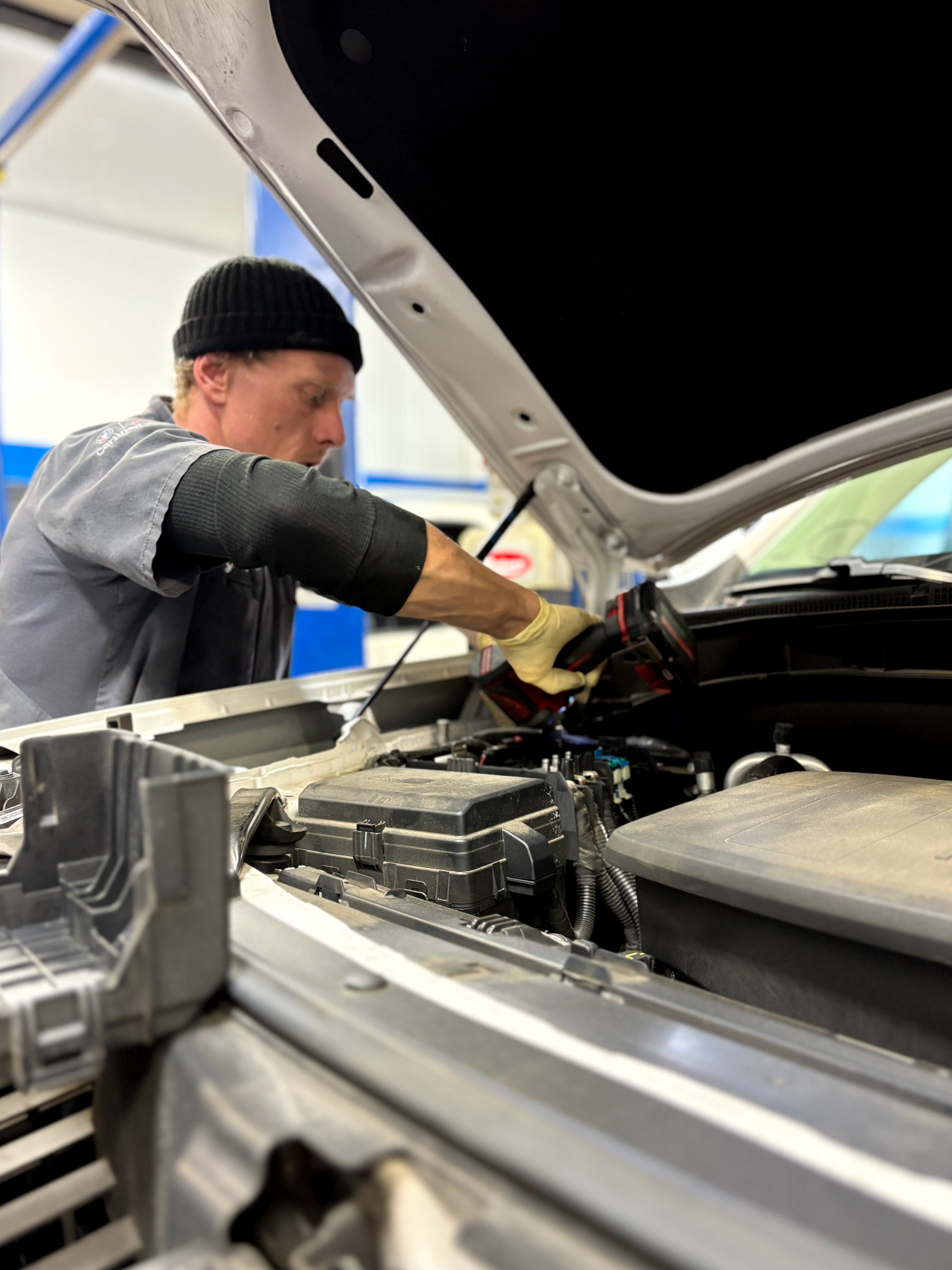
EV service is not a replacement for traditional auto repair — it is a specialization that runs alongside it. This article gives an honest overview of what an EV technician actually works on, and does not provide step-by-step high-voltage procedures. Those belong in manufacturer training with proper equipment and instruction.
How EV service differs from conventional vehicle service
EVs eliminate engine oil, spark plugs, and the majority of traditional powertrain wear items. In their place: high-voltage battery systems, one or more electric drive units, complex thermal-management systems, and different braking behavior driven by regenerative braking. Many maintenance procedures on the rest of the vehicle (tires, brakes, suspension, HVAC, 12-volt systems) are similar to internal-combustion service.
High-voltage safety
High-voltage systems in EVs typically operate at 400 to 800 volts DC. Contact can be lethal. OSHA and manufacturer training address de-energizing procedures, verification, PPE, and safe work zones. Technicians who work on high-voltage systems are trained in specific service disconnect procedures and use insulated tools and gloves rated for the voltage class.
Battery systems
The high-voltage battery pack is the most expensive component in an EV and requires specialized diagnostic tools. Techs check state-of-health, isolation, thermal management, and communication with the vehicle's battery management system. Repair versus replacement decisions are usually driven by manufacturer procedures.
Electric drive units
The electric motor, inverter, and gear reduction unit combine into what is usually called an electric drive unit. Diagnostic work focuses on electrical testing, cooling, and communication with the vehicle control units. Mechanical failure is less common than in internal-combustion drivetrains.
Thermal-management systems
EVs use liquid cooling for the battery, drive unit, and often the cabin heater. Coolant leaks, pump failures, and refrigerant faults on integrated systems are common service items. The heat pump systems used in modern EVs are more complex than a traditional A/C loop.
Charging systems
Technicians diagnose onboard chargers, DC fast charging communication, and charge-port hardware. Field diagnosis often involves distinguishing vehicle faults from external charger or utility-side issues.
Low-voltage electrical systems
EVs still rely on a 12-volt system for many control modules, lighting, and infotainment. A dead 12-volt battery can leave an EV unable to start even with a full high-voltage pack.
Diagnostic software
OEM diagnostic software controls the majority of EV work. Software updates, reprogramming, and module coding are routine. Comfort with computers, cables, and manufacturer service information portals is essential.
Isolation and safety procedures
"Isolation" refers to keeping the high-voltage system electrically separated from the vehicle chassis. Testing insulation resistance is a common diagnostic step and a safety check after any high-voltage service.
Required personal protective equipment
Typical PPE includes high-voltage insulated gloves (with regular dielectric testing), insulated tools, safety glasses, and face shields for specific tasks. Shops that perform high-voltage service maintain documentation for glove testing intervals and provide dedicated work areas.
Training and certification considerations
EV service typically requires manufacturer-specific training. ASE also offers an Electric Vehicle Technician Safety certification (xEV Level 1) and additional service tests. Employer requirements vary.
Transferable skills from traditional automotive repair
- Diagnostic thinking, wiring diagrams, and CAN network troubleshooting
- HVAC and refrigeration fundamentals
- Chassis, brakes, and suspension service
- Scan-tool proficiency and OEM information systems
- Safe vehicle handling and lifting practices
EV career outlook without unsupported predictions
EV service volume is growing as EV registrations grow. How quickly that translates into full-time EV workloads varies by market and by dealership. Cross-training on both EV and internal-combustion vehicles is currently the most realistic career strategy.
Questions to ask an EV-service employer
- What EV training do you send technicians to, and is it paid?
- What PPE does the shop supply, and how is it tested?
- How is EV work dispatched relative to internal-combustion work?
- What EV volume does this store see today?
Curious about a career at Patriot?
Explore opportunities with Patriot Chevrolet and Patriot Buick GMC in Limerick, Boyertown and Warminster, Pennsylvania. Available opportunities may vary by location, and submitting an interest form does not guarantee an interview or employment offer.
Frequently asked questions
- Do I need to be an electrician to work on EVs?
- No. Automotive high-voltage systems are trained through automotive manufacturer programs and ASE, not through electrician licensing. Basic electrical fundamentals are important.
- Is EV work more dangerous than internal-combustion work?
- Different, not universally more dangerous. With proper training and PPE, high-voltage service is safe. Without proper training, it can be lethal — which is why manufacturers require certification before authorizing this work.
- Will EV service replace all internal-combustion service jobs?
- Not in any near-term timeframe. Internal-combustion vehicles will require service for many years, even as new-vehicle sales shift toward EVs.
Sources
- Electric and Hybrid-Electric Vehicles — Safety and Health Topics — Occupational Safety and Health Administration
- About ASE Certification — National Institute for Automotive Service Excellence (ASE)
- Automotive Service Technicians and Mechanics — Occupational Outlook Handbook — U.S. Bureau of Labor Statistics (2024 data)
- GM Dealer Technician Careers — General Motors
Last reviewed July 24, 2026. Time-sensitive figures should be re-verified against the original source before use.
Related articles
Training and Certifications
How to Become a GM-Certified Automotive Technician
A plain-language look at manufacturer training for GM, Chevrolet, Buick and GMC service, and how it typically fits with ASE certification.
Career Development
Automotive Technician Career Path: From Apprentice to Master Technician
The realistic progression from entry-level maintenance work to master technician, diagnostic specialist, or shop leadership.
Career Development
Automotive Technician Tools: What Employers Provide and What Techs May Need
A realistic overview of what tools technicians typically own, what the shop is expected to provide, and how to evaluate a tool policy.